
Could Your Window Furnishing Business Double Without Doubling the Complexity?

Growth is what every business wants.
More enquiries > more sales > more customers > more opportunities.
But for window furnishing businesses, growth brings another challenge with it: COMPLEXITY.
More leads mean more appointments. More sales mean more measurements, quotes and orders. More products mean more configurations, pricing rules and suppliers. More jobs mean more coordination between salespeople, administration, manufacturing, installers and customers.
So there’s an important question every growing window furnishing business should ask:
If your sales doubled over the next three years, could your current systems handle it without doubling your administration?
The opportunity is significant. So is the operational pressure.
If your sales doubled over the next three years, could your current systems handle it without doubling your administration?
For many businesses, this is where the limitations of their existing systems begin to show.
Growth has a hidden cost
Think about how much information moves through your business between the first customer enquiry and the final installation.
A lead comes in and an appointment is booked. A salesperson visits the customer, measures the windows, discusses products and prepares a quote. Photos and site information may need to be captured. The customer makes changes. A check measure may be required. Products need to be ordered from suppliers or sent through manufacturing. Installers need to be scheduled. Customers need to be kept informed. The job is completed, invoiced and paid.
Now ask:
How many times is information manually entered, copied, emailed, messaged or explained during that journey?
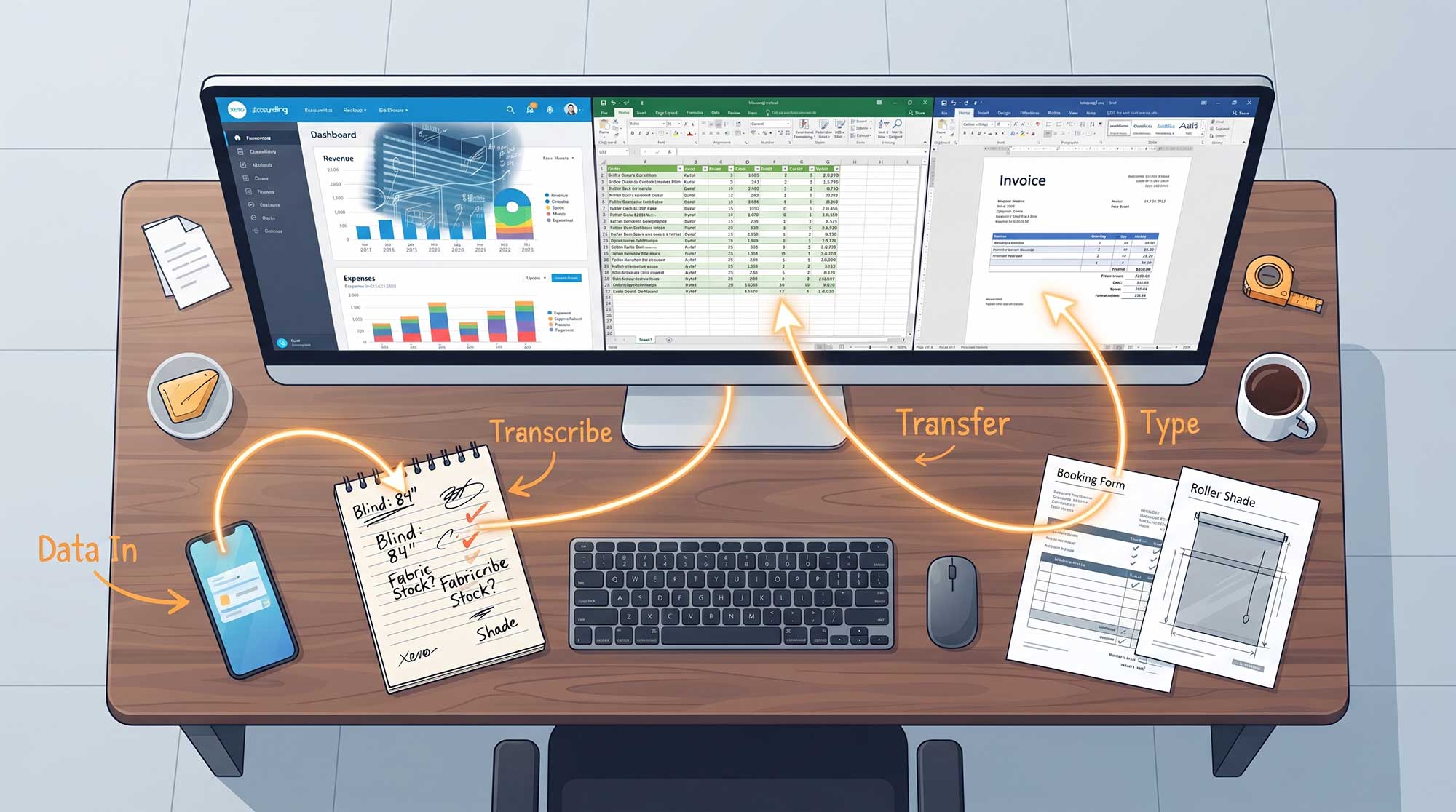
When a business is small, the answer may not matter very much.
A spreadsheet keeps track of the jobs. The salesperson knows what the customer wanted. Someone in the office remembers which supplier needs the order. The installer calls if something doesn’t make sense.
But as the business grows, those informal processes become harder to manage.
More leads × more salespeople × more products × more options × more suppliers × more jobs × more installers × more branches = dramatically more complexity.
Eventually, spreadsheets, separate applications and people’s memories start becoming part of the problem.
Information gets entered twice. Someone works from an old version. A customer change isn’t communicated. An installation note is missed. A salesperson discounts something incorrectly. An administrator spends time chasing information that already exists somewhere else in the business.
And when something goes wrong, another important question appears:
How easily can you identify where it went wrong and why?
Was the original measurement incorrect? Was the wrong product configured? Did something change at check measure? Did the supplier receive the correct information? Did manufacturing have the latest specifications? Did the installer receive the notes from the salesperson?
The larger the business becomes, the harder those questions can be to answer when information is spread across multiple systems and people.
The challenge isn’t simply administration.
It’s control over complexity.
What if growth created capacity instead?
Now consider the alternative.
What if your sales increased without your administration increasing at the same rate?
What if salespeople spent more time selling and less time entering information? What if product and pricing rules helped them get quotes right the first time? What if information captured in the customer’s home followed the job through check measure, ordering, production and installation?
What if salespeople, measurers and installers spent less time driving because their schedules and routes were better organised?
And what if management could see what was happening across the business without having to pull information together from spreadsheets, emails and separate applications?
That means more sales capacity, fewer errors, less administration, better utilisation of field staff, stronger margin protection, faster customer turnaround and better management information.
That’s the problem Insyte is designed to solve.
Rather than treating CRM, quoting, scheduling, manufacturing and installation as separate activities, Insyte connects them as parts of the same customer journey.
A customer enquiry becomes a lead. The lead becomes an appointment. Measurements and product requirements are captured. Products are configured and quoted. The customer accepts. Check measures, supplier orders or manufacturing follow. Installation is scheduled. The job is completed and paid.
The information moves with the job.
Built around the way window furnishing businesses actually operate

The difference is important because window furnishings aren’t a simple off-the-shelf retail transaction.
Every job can involve different windows, measurements, products, fabrics, colours, controls, motors, mounting conditions and installation requirements.
That complexity is difficult to manage with generic software.
Insyte combines industry-specific CRM and CPQ with operational tools designed around the way window furnishing businesses actually work.
Product configurators can help ensure salespeople select valid product combinations and apply the correct pricing and discounting rules. This doesn’t just make quoting faster; it can help protect margin and reduce errors before they reach ordering or production.
Insyte Sketch tackles another common source of problems: transferring what the salesperson or measurer saw at the customer’s property to everyone who needs that information later.
Photos, drawings, annotations and site information can become part of the job rather than sitting separately on someone’s phone, in an email or on a piece of paper.
That creates a much clearer flow of information between sales, check measure, administration, manufacturing and installation.
And because Insyte is configurable, the objective isn’t to force every window furnishing business into exactly the same workflow. Products, processes and automation can be configured around the way the business operates.
That becomes increasingly important as a company grows and develops its own way of selling and delivering work.
Automation changes the economics of growth
Perhaps one of the biggest opportunities is removing repetitive administration.
A growing business contains hundreds of small activities that individually don’t seem significant: assigning leads, confirming appointments, following up quotes, updating customers, scheduling check measures, communicating with installers, processing commissions and moving information between systems.
Five minutes here and ten minutes there doesn’t sound like much.
Across thousands of leads, quotes and jobs, it becomes a substantial cost.
Automation allows many of those processes to happen consistently without relying on someone remembering the next step.
The result isn’t simply “saving time”.
It’s the ability to increase the amount of business your existing team can handle.
The same principle applies to field teams. Sales consultants, measurers and installers are valuable resources. Time spent unnecessarily driving across a city is time they aren’t spending with customers or completing jobs. Better scheduling and route optimisation can help turn some of that lost time back into productive capacity.
At the same time, connected reporting gives management greater visibility into what is actually happening across the organisation: where leads are coming from, how sales are performing, where jobs are in the process and where improvements can be made.
As a business becomes larger, that visibility becomes increasingly important. Management can no longer rely on knowing every customer, every quote and every job personally.
The business needs systems to provide that visibility.
The question isn’t whether your software works today
Many businesses don’t change systems because their existing setup is completely broken.
They change because they’ve outgrown it.
The spreadsheet still works. The quoting system still produces quotes. The calendar still books appointments.
But behind the scenes, more people are being added to coordinate everything. More information is being transferred manually. More processes depend on particular employees. More management time is spent finding out what’s happening.
That’s why the better question isn’t: “Does our current software work?”
It’s: “Could our current systems handle twice the business without twice the administration, twice the mistakes and twice the complexity?”
Because ultimately, that’s what scalable business systems should make possible.
Insyte brings together CRM, industry-specific CPQ, Sketch, automation, scheduling, route optimisation, supplier and manufacturing processes, installation, payments and reporting within one connected platform designed for the window furnishing industry.
But those features aren’t the end goal.
The goal is more capacity without unnecessary administration. More control without micromanagement. Better protection of margin. Less dependence on information held by individual employees. Better visibility for management. And a better experience for customers.

In other words:
A better-run window furnishing business.
Because when your business grows, your systems shouldn’t add to the complexity.
They should help you control it.
Explore how Insyte is built around the way window furnishing businesses actually operate and grow HERE.

For more great information like this, signup to our newsletter
